

In the 8th century, when Japan’s imperial court ruled from Nara, a powerful government and military center emerged in the north. It was called Tagajo and would serve as the heart of the Tohoku Region for roughly 300 years. Today, I visit the ruins of Tagajo Castle and its newly reconstructed South Gate, playing tourist on the “Journey Through a Thousand Years in a Single Day: Shiogama, Shichigahama, and Tagajo Tour,” designed by Tour Wave. On the way, I’ll explore Tagajo’s coastal neighbors, Shiogama and Shichigahama, for a full day experience with food, drink, culture, and a thousand years of history.

Shiogama Shrine: A Sacred Site Connected to Salt and the Sea
Our tour begins in the Shiogama, which these days is known for its bustling port and Japan’s largest haul of tuna. Long ago, however, Shiogama’s fortune flowed from another treasure: salt. How much salt was produced here over the centuries? It’s safe to say a lot, and much of it was likely sent to Tagajo.
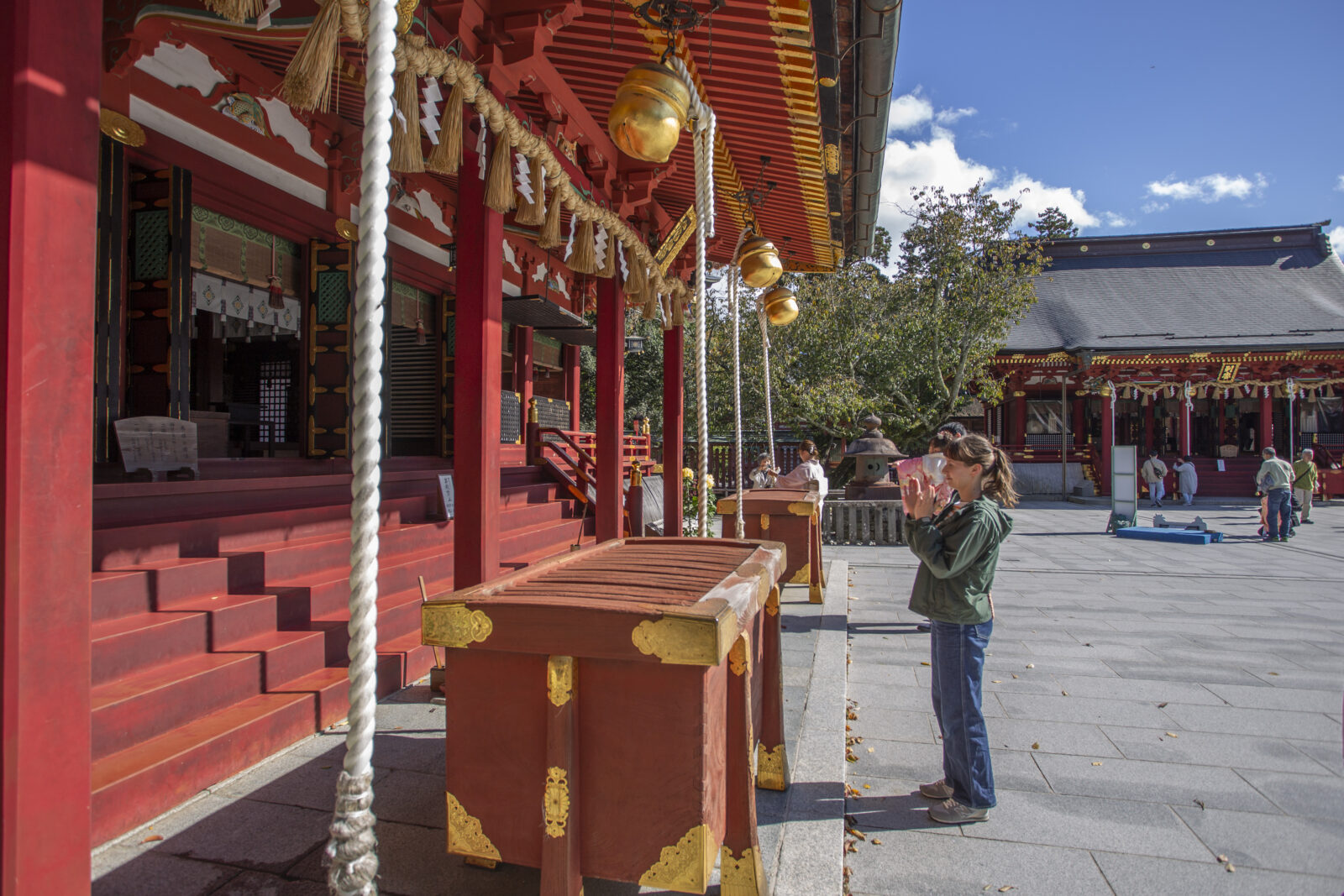
We ascend the long flight of stone steps to Shiogama Shrine. This grand Shinto shrine, which predates written record, enshrines multiple deities, the main one being Shiotsuchi Oji no Kami, a god of safe navigation and childbirth said to have taught the local people how to make salt from seawater long, long ago. This morning, the shrine is alive with color and excitement as families, dressed in their best, gather for the traditional event Shichigosan. With its 15 buildings designated as Important Cultural Properties and its cherry trees glowing red and gold in the autumn sun, Shiogama Shrine is as spiritual as it is breathtaking.

Urakasumi: A Sake Brewery with 300 Years of History
From Shiogama Shrine, we head to historic sake brewery Urakasumi, founded in 1724 and still run by the Saura family. Since I’ve lived in Sendai, I’ve come to know and love Urakasumi’s sake, which is always exquisite when paired with seafood, but it has been a few years since I’ve visited their Meiji period storefront. Okay, so it’s earlier than I’d usually go for a drink, but today I’m playing the tourist. I’ll indulge.
I meet the sake gallery manager Hiroya Sugawara, who introduces me to the varieties available for tasting today, served with a sake cup I can take home. I try the clear and balanced Kura no Hana Junmai Ginjo and the smooth and fruity-fragrant seasonal junmaisake, both brewed from special Miyagi-grown rice developed exclusively for sake. Since I’m “on vacation,” I can’t resist his final suggestion: Urakasumi Umeshu, a light, tart, and slightly sweet plum wine made by extracting plum compounds with a sake base at low temperature. It’s delightful.


Shiogama Fish Park: From Port to Plate
A good drink demands good food, and lucky for me the tour continues to Shiogama Port’s 4,950 square meter public market, Shiogama Fish Park. Celebrating its 60th anniversary this year, the market hums with energy. The colder months are a particularly good time to visit, as the mouthwatering wild-caught Sanriku Higashimono tuna, only available from September to December, is in season. I join the lunchtime rush, picking out slices of sashimi and head to the market’s “DIY sushi bowl” counter to build my own sushi bowl with rice and miso soup. It does not get any fresher than this.


Shichigahama: A Dynamic View of Matsushima Bay
With lunch digested, we drive on to Shichigahama, a seaside town whose name means “seven beaches.” The peninsula is popular with surfers and stand-up paddleboarders, but our goal is the “Dynamic View,” one the the four famous views of Matsushima Bay, which is one of the “Three Most Scenic Spots in Japan.” Standing atop the hill Tamonzan, I gaze out at the pine-clad islands scattered across the bay. A sightseeing boat glides through water below, leaving white waves like brushstrokes. It’s easy to see why this very view graced a well-known 1960s postcard.

The Tohoku History Museum: Discovering Northern Japan’s Past
After a quick stop at the Shichigahama Tourist Community Center for some gift shopping, we head towards our last destination, Tagajo. Before arriving, we visit the Tohoku History Museum, which houses exhibits on the history and archeological discoveries of northeastern region. from the Paleolithic Period to the Modern Age. Inside, large displays about the Tagajo Castle site make this the perfect place to study up in advance.

The museum café, &Sun, offers a comfortable place to rest, with wide windows overlooking trees and water features. I order a coffee and their ancient rice ice cream, made from a rice variety cultivated right beside the castle ruins. It’s slightly nutty, subtly sweet, and gives me a nice boost of energy for the tour’s final stop.

Tagajo Castle Ruins: Traces of a Powerful Outpost in the North
The Tagajo Castle Ruins, one of the Three Great Historic Sites of Japan, was not actually a castle, but a government administrative and military center responsible for the entire Tohoku region from the year 724. It endured and was rebuilt enemy attacks, fires, and earthquakes over the course of roughly 300 years, before falling into decline in the 11th century and fading to legend and poetry. Whether it even existed or not would remain a mystery for hundreds of years more.
I meet Takao Funaki of the Tagajo City Hall, my genial and knowledgeable guide, at the Tagajo Castle Ruins Information Center, which houses state-of-the-art digital exhibits with interactive 3D models that bring the lost grandeur of the buildings that once stood here to life.
Before I know it, I’m dressed in a Nara-period costume with long, draping sleeves and being led towards the South Gate. The cameraman snaps away gleefully as I pose, somewhat awkwardly, in front of it.The South Gate itself is a relatively new landmark, opened in April 2025. The magnificent structure, which stands atop a hill, is an impressive 14.5 meters high, reconstructed with careful attention paid to historical detail. “Notice the earthen walls, as well,” Funaki says, pointing upward. “They don’t slope straight down. There’s a subtle wave to them, a characteristic which reflects research findings on the terrain when the gate was originally built.” The earthen walls on either side of the gate, he tells me, were built layer by layer, as they would have been in the 8th century.

On the other side of the gate lies one of Tohoku’s most important historical artefacts: the Tagajo stele, a stone monument with inscriptions detailing the founding of Tagajo Castle and listing its distance to the capital, Heijo-kyo, and other provinces. When the stele was discovered in the mid-1600s, buried underground, it caused a sensation and aroused suspicions. How had its inscriptions remained legible after hundreds of years? Had it been forged, as some claimed, by Sendai’s samurai clan, the Dates, eager to glorify the north? The controversy raged well into the Meiji era (1868-1912). Only in the 1960s did excavation of the Tagajo Castle Ruins confirm its authenticity.

Funaki suggests a simple explanation for the stone’s pristine condition. Perhaps it had fallen face down, protecting it from centuries of wind and rain. Whatever the case, its preservation is miraculous, and without it, the ruins of Tagajo Castle may have been lost forever. The Tagajo Stele was designated a National Treasure in 2024.
Next, I am led to the ruins of the Former Government Headquarters. Its earthen walls and wooden beams are long gone, but the stone foundations remain. Funaki points toward the distant south, “That way was the capital, Heijo-kyo, Nara today.” Around the ruins are open lawns and cherry trees that will draw crowds of revellers for cherry blossom viewing come spring. Beneath the picturesque landscape, Funaki tells me, is a layered past: joyous festivals, solemn ceremonies, and even the grim punishments of captured Emishi warriors. Like all places, Tagajo’s history is complex.
As the sun begins to set, the South Gate glows under spotlights. In the distance, the lights of Sendai sparkle. “It makes you wonder how dark the nights were back then,” my guide muses.
“Or how bright Tagajo must have shone,” I reply, thinking back on Shiogama and Shichigahama, and how their fortunes were entwined with Tagajo’s.
Standing between the past and the present, I remember the poet Basho’s reflections on the Tagajo stele, which he visited and recorded in his travel memoir, The Narrow Road to the Deep North. Even as time passes and landscapes change, through monuments like these, we can glimpse the hearts of those who lived long ago.

