

As late autumn burns into winter, southern Iwate reveals its deepest colors. The earthen warmth of a Zen meal, the gilded silence of a gorge, and the slow black stroke of a lacquer brush. Here, the cold does not mute the world; instead, it serves as a stark canvas, making the region’s nature and craft shine with their most vivid intensity.
Oshu City
Zen Cuisine & Nirvana Painting at Shoboji Temple

Deep in the mountains, Shoboji rests beneath Japan’s largest thatched roof. Inside, the dim air feels still and cool—an ideal setting for Shojin Ryori (Zen cuisine).
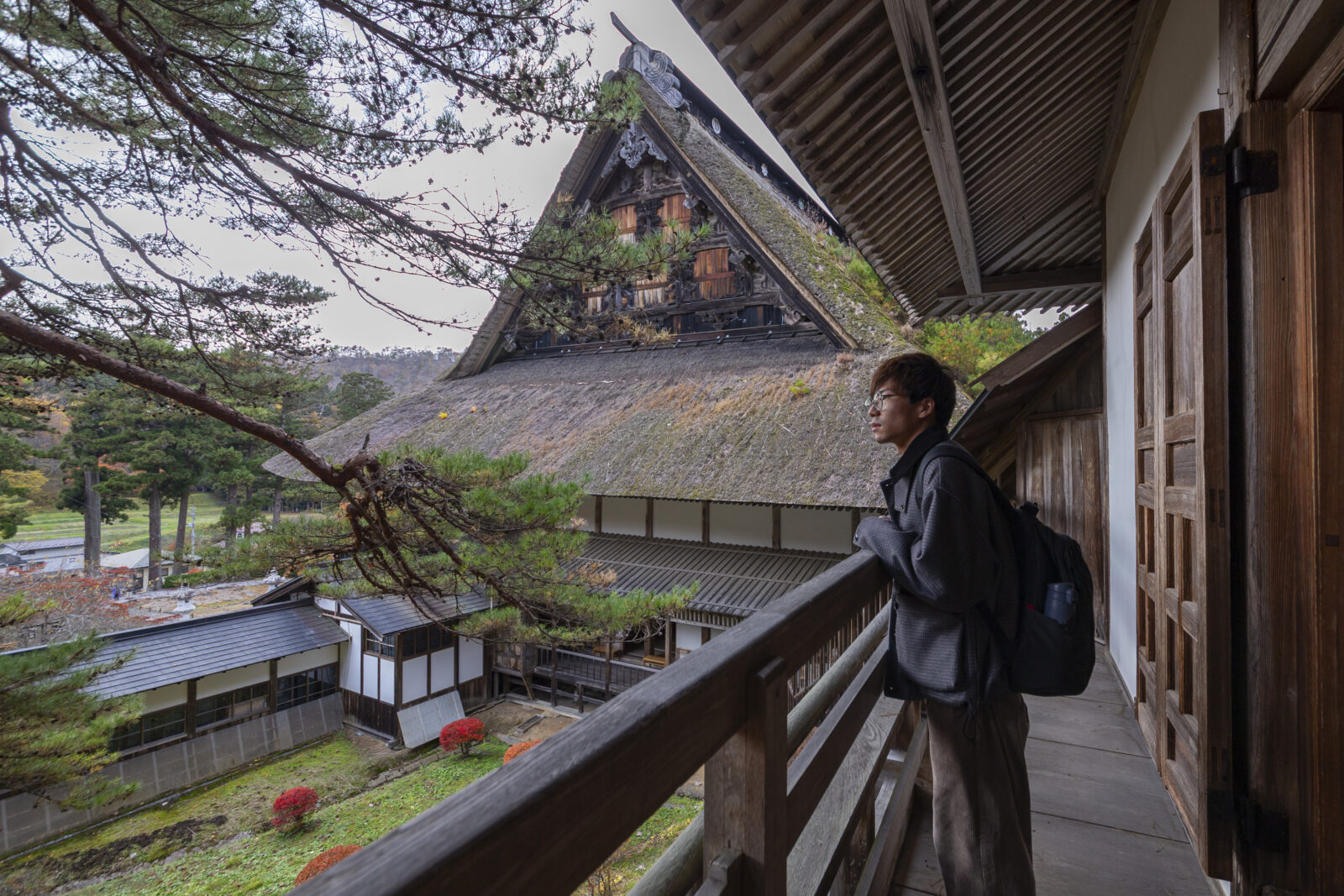
The meal is a meditation. Rooted in the tenets of the Soto school, it treats eating as a vital practice—one that eschews meat and fish to celebrate the pure, seasonal essence of every ingredient. It begins with a chant and three deliberate bites of rice, followed by dishes like Kissho Konbu, auspicious kelp fried into an intricate bellows shape that snaps softly between the teeth. Each action carries intention. Diners save a slice of pickled radish to wipe the bowl clean with tea—an elegant gesture that wastes nothing, not even water.

This quiet mindfulness prepares you for the temple’s massive Nirvana painting. More than an artwork, it feels like a space you step into; standing before it, you sense the hush of the Buddha’s final moments extending outward, as if time briefly widens.

Inquiries / Contact Information
Shoboji Temple (Shojin Ryori Experience)
Price: 5,000 yen (Includes admission, Wajima lacquer chopsticks, and limited-edition Shojin Ryori Goshuin)
Shoboji-129 Mizusawaku Kuroishicho, Oshu, Iwate 023-0101
Tel: 0197-264-041
Ichinoseki City
Geibikei Gorge Boat Ride

The Satetsu River slices through 50-meter limestone cliffs, forming the quiet grandeur of Geibikei Gorge. Flat-bottomed boats—once used to carry horses—are still guided by a single pole, a technique unique in Tohoku. While deep winter brings the intimate warmth of kotatsu boats drifting through snow, today the gorge burns with the gilded hues of late autumn. The only sound is the soft splash of the pole.

At the turnaround point, passengers toss undama—clay stones stamped with “Luck” or “Love”—toward a hollow in the cliff. Whether they land or fall, the moment becomes a brief bond among strangers.

The ride back feels lighter, friendlier. The boatman jokes easily, and as boats glide past one another, passengers trade bright hellos in whatever language they carry. Then comes his “Geibikei Oiwake,” rising and falling against the canyon walls—a song that seems to gather the whole river into one shared hush. It is a communal warmth, shared with strangers and trailing ducks, suspended on freezing waters.
Inquiries / Contact Information
Geibikei Gorge (Geibi Tourist Center)
46-7, Higashiyama-cho Nagasaka, Ichinoseki, Iwate 029-0302
Tel: 0191-47-2341
Hiraizumi Town
Lacquerware Painting at Ochiya

Hidehira-nuri originated with Fujiwara no Hidehira, the third generation of the Oshu Fujiwara clan. He invited master artisans from Kyoto to create vessels using lavish amounts of local lacquer and gold. At Ochiya, visitors can touch the depth of this history by painting their own spoon or chopsticks.
Working with the material reveals its temperamental nature. Lacquer is viscous, moving like thick honey. When my brush moves too fast, the artisan gently advises, “Slow down.” A rushed stroke leaves jagged marks, but a slow, deliberate pull allows the lacquer to “level” itself, settling into a smooth finish. As I carefully paint a maple leaf, I realize that this craft requires listening to the material rather than forcing it. Learning to wait for the lacquer to settle gave me a profound respect for the skill required to maintain this centuries-old art.

Inquiries / Contact Information
Ochiya Lacquerware
Price: 4,000 yen (Traditional Lacquer Painting Experience)
Koromonoseki-1-7 Hiraizumi, Nishiiwai District, Iwate 029-4102
Tel: 0191-46-2306
